


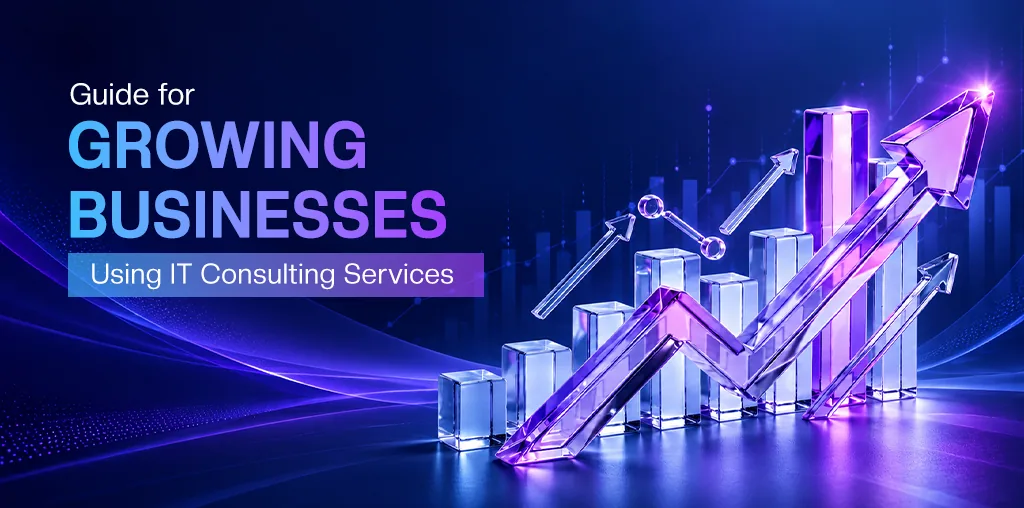
Guide for Growing Businesses Using IT Consulting Services
 By Pro Integrate Team
 Wed, Nov 25, 2026
Updated: Wed, Nov 25, 2026
6 min read
 IT Consulting Services
In this article
Growth often creates a technology problem that businesses do not see coming. As teams expand, they add CRM platforms, ERP systems, cloud applications and other tools to support new processes. Over time, these systems may stop working together effectively, creating data silos, manual work and slower decision-making.
The challenge is no longer simply having the right software. It is making sure the technology environment can connect, scale and support where the business is going.
This is where IT consulting services can help growing businesses move from reactive technology fixes to a more strategic approach to architecture, integration and automation.
Key Takeaways
- Business growth can expose integration, cloud, workflow and data challenges across the technology environment.
- IT consulting can help businesses connect applications, improve cloud architecture and automate processes as they scale.
- Enterprise integration, cloud strategy, automation and AI can address different technology needs as business requirements evolve.
- Growing businesses need a technology approach that balances scalability, security, performance and operational efficiency.
- The right consulting partner should understand the wider technology ecosystem and provide end-to-end support from strategy through implementation.
Core Technology Challenges for Growing Businesses
1. Disconnected Systems
When a business expands its software toolkit, critical information gets trapped in separate silos like CRM, ERP, and finance tools. Without smooth, native communication between these platforms, employees must resort to manual data entry and messy workarounds.
This creates immediate operational friction. It triggers data entry errors, stalls daily workflows, and blocks employees from accessing the real-time information they need to do their jobs. A well-planned enterprise integration approach is how most businesses solve this.
2. Cloud Inefficiencies
Migrating operations to the cloud offers scale, but throwing more resources at a cloud environment does not automatically create an efficient setup.
As software workloads scale across platforms like AWS, Azure, or Google Cloud, companies face complex choices around performance, security, and cost. Partnering with IT consulting services in India is a practical way to map out a smart cloud architecture, keeping your cloud bills under control while maximising your actual returns.
3. Process Bottlenecks
Business growth quickly exposes flaws in workflows that used to work fine on a smaller scale. Tasks that once took a few manual steps turn into major operational roadblocks as transaction volumes and team sizes multiply.
Legacy systems compound this issue when core business rules remain hardcoded into ageing software. Introducing modern automation and structured process management can clear these blocks and eliminate daily, repetitive chores.
4. Data Without Enough Insight
Fast-growing enterprises generate massive amounts of information, but accumulating raw data does not automatically yield strategic value.
The real hurdle lies in building a solid infrastructure that links these separate sources so analytics and AI tools can actually guide business strategy. Without this integrated foundation, organisations simply accumulate files rather than uncovering clear, actionable directions. Our big data consulting services help build that foundation.
What High-Impact IT Consulting Looks Like
Effective consulting goes beyond just recommending a new software tool; it fixes the underlying technology environment.
- Enterprise Application Integration: True integration connects platforms so they can seamlessly share data. Instead of building messy, fragile bridges between tools, consultants use middleware and integration platforms like MuleSoft, Dell Boomi, or webMethods. The goal is to build a modern integration architecture that effortlessly accommodates new applications as business needs shift.
- Cloud and Architecture Strategy: A reliable cloud framework coordinates how your infrastructure, applications, and data flow together. Consultants evaluate complex hybrid or multi-cloud setups across AWS, Azure, and Google Cloud—keeping a sharp focus on balancing scalability and security against performance and operational costs.
- Business Process Automation: Automation strips the manual friction out of workflows that have grown too bloated to manage at scale. Whether it involves linking applications, routing digital approvals, shifting data, or re-engineering workflows, the goal is simple: eliminate wasted steps while keeping your core business logic intact.
- AI and Machine Learning Integration: Artificial intelligence delivers real value only when it solves a specific business problem, not when it is adopted just to chase a trend. Depending on the goal, businesses can implement practical solutions like Retrieval-Augmented Generation (RAG), predictive modelling, or machine learning to turn raw data into operational wins.
Why Pro Integrate
The right technology partner should understand the entire software environment rather than looking at systems in isolation. As a renowned IT consulting companies in India, Pro Integrate brings deep platform expertise and true flexibility across cloud-native, open-source, and proprietary systems instead of forcing a single vendor solution.
A proven track record in IT consulting services India ensures the successful management of highly complex integrations, offering end-to-end capability from initial proof of concept through implementation and post-launch optimisation. The company establishes clear delivery accountability for every stage, including testing and knowledge transfer, and always takes the time to explain exactly why a specific technical approach makes sense for long-term business goals rather than just pitching what is familiar.
Conclusion
For growing businesses, technology should support expansion rather than become a constraint. Connecting applications, improving cloud architecture, automating processes and making better use of data can create a technology environment that is easier to scale.
The role of a technology consulting partner is to help make those changes in a structured way, linking technical decisions to business requirements and future growth.
Choosing a partner? Read our guide on how to choose the right technology consulting partner, or talk to our team about your technology goals.
Frequently Asked Questions
Why do growing businesses need IT consulting services?
Growth often creates technology problems that businesses do not see coming. As teams add CRM platforms, ERP systems and cloud applications, these tools may stop working together, creating data silos, manual work and slower decision-making. IT consulting helps move from reactive technology fixes to a more strategic approach to architecture, integration and automation.
What technology challenges do growing businesses commonly face?
The four core challenges are disconnected systems, cloud inefficiencies, process bottlenecks and data without enough insight. Each one becomes more visible as transaction volumes, team sizes and software workloads grow.
What does high-impact IT consulting include?
High-impact IT consulting fixes the underlying technology environment rather than just recommending a new tool. It typically covers enterprise application integration using platforms like MuleSoft, Dell Boomi or webMethods, cloud and architecture strategy, business process automation, and practical AI and machine learning integration.
How can IT consulting help control cloud costs?
Adding more resources to a cloud environment does not automatically make it efficient. Consultants map out a cloud architecture across platforms such as AWS, Azure and Google Cloud, balancing scalability and security against performance and operational costs, so cloud spending stays under control while returns are maximised.
What should I look for in an IT consulting partner?
The right partner should understand the entire software environment rather than looking at systems in isolation, and offer flexibility across cloud-native, open-source and proprietary systems. It should provide end-to-end capability from proof of concept through implementation and post-launch optimisation, with clear delivery accountability, testing and knowledge transfer at every stage.
Keep reading
 IT Consulting Services
How to Choose the Right Technology Consulting Partner
Nov 5, 2026
 IT Consulting Services
Top IT Consulting Firms in India: How to Evaluate a Potential Technology Partner
Sep 17, 2026
 IT Consulting Services
IT Staff Augmentation Services vs Traditional Hiring: Which Is Right for Your Business?
Aug 31, 2026